




Stainless steel is widely used in construction, furniture, industry, household goods, and manufacturing due to its corrosion resistance, high durability, and good aesthetics. However, not all types of stainless steel have the same properties and applications.
In the current market, stainless steel 201, stainless steel 304, stainless steel 316, and stainless steel 430 These are the most commonly used types. Each type has different composition, corrosion resistance, durability, and price, suitable for different needs. This article from Hoa Giang will help you understand the most popular types of stainless steel currently available, their outstanding characteristics, and practical applications so you can make the most suitable choice.
Nội dung chính
- 1 1. What is stainless steel?
- 2 2. The most common types of stainless steel currently available.
- 2.1 304 stainless steel – the “king” of stainless steels.
- 2.2 316 Stainless Steel – Specifically designed for harsh environments.
- 2.3 Stainless steel 201 – An economical solution
- 2.4 Stainless steel 430 – Representing the Ferritic group
- 2.5 Inox 410, Inox 420
- 2.6 Duplex Stainless Steel – Combining superior advantages
- 3 3. Quick comparison table of common types of stainless steel
- 4 4. Simple ways to distinguish different types of stainless steel at home.
- 5 5. Common types of stainless steel surfaces
- 6 Factors to consider when choosing stainless steel
- 7 FAQ – Frequently Asked Questions about Stainless Steel
- 8 Hoa Giang – A supplier of high-quality stainless steel for all construction projects.
- 9 Conclude
1. What is stainless steel?
Stainless steel is an alloy of iron with a minimum of 10.5% chromium, along with other elements such as nickel, manganese, molybdenum, carbon, etc.
Thanks to its high chromium content, a super-thin, self-regenerating chromium oxide film forms on the surface of stainless steel, giving the material superior corrosion resistance, rust prevention, and oxidation resistance compared to ordinary steel.
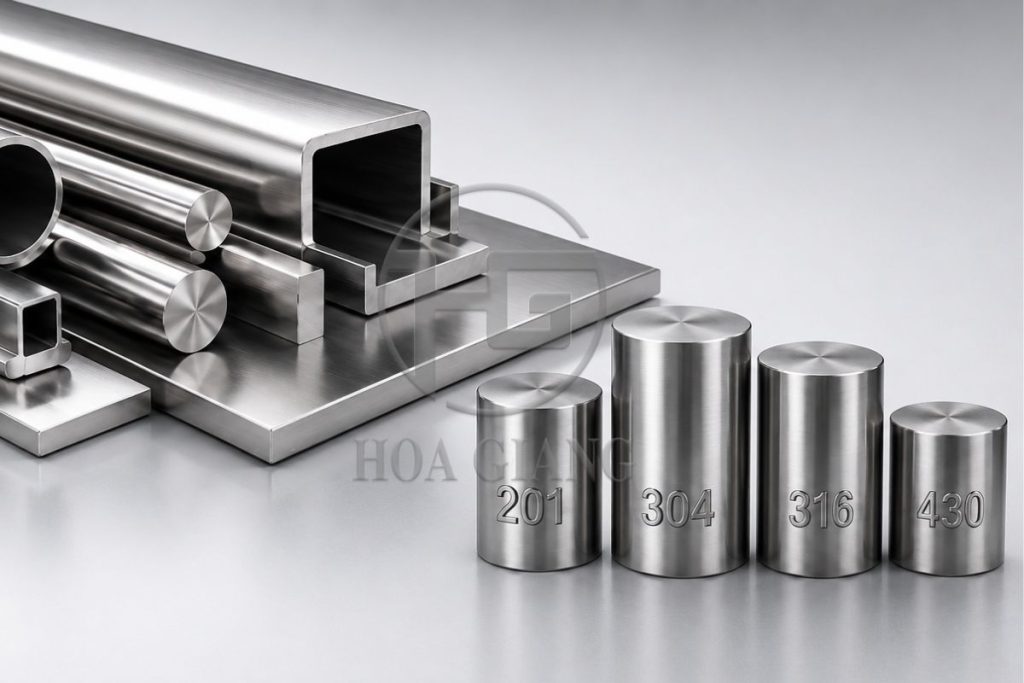
Some common types of stainless steel
Based on crystal structure and alloy composition, stainless steel is divided into four main groups: Austenitic, Ferritic, Martensitic, and Duplex. Each group contains many different grades, the most common being 201, 304, 316, 430, etc.
2. The most common types of stainless steel currently available.
304 stainless steel – the “king” of stainless steels.
Stainless steel 304 belongs to the Austenitic group, containing approximately 18% chromium and 8% nickel (also known as 18/8 stainless steel). This is the most widely used type of stainless steel on the market today due to its perfect balance of cost, durability, and corrosion resistance.
Key features:
- Excellent resistance to rust and oxidation in air, water, and mild chemicals.
- High mechanical strength, easily bent, easily welded, and easily machined.
- Glossy surface, high aesthetic appeal.
- Non-magnetic or very weakly magnetic.
- Safe for direct contact with food.
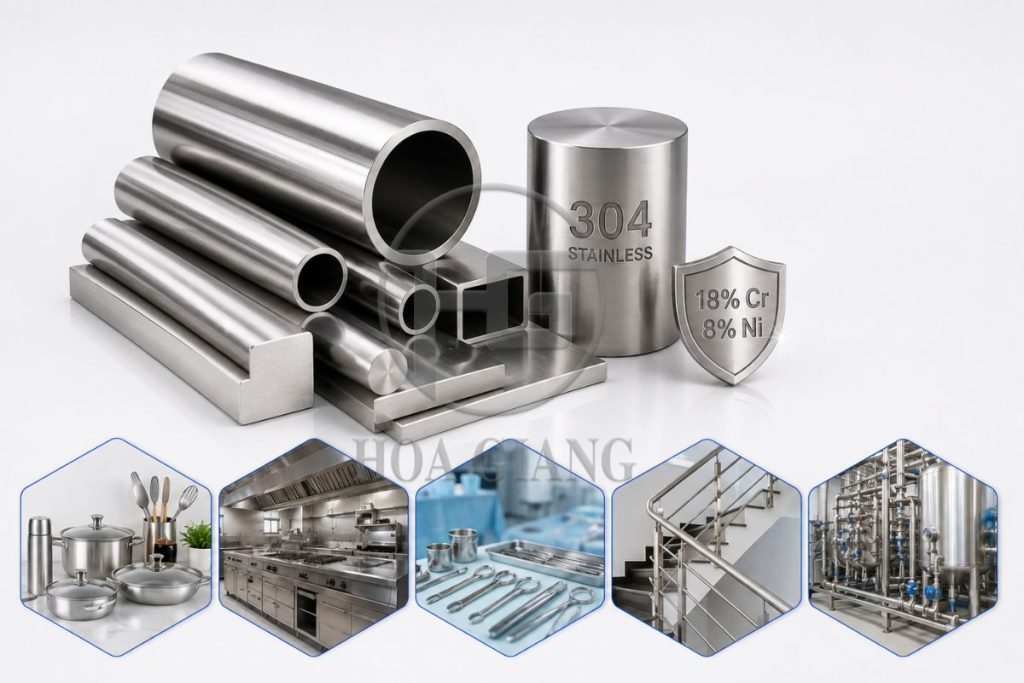
Applications of 304 stainless steel
Application:
- Household items: pots, pans, sink, cutlery, thermos flask
- Industrial kitchen equipment for restaurants and hotels.
- Medical equipment, surgical instruments
- Interior furnishings, railings, stair handrails
- Tanks and pipelines in the food and pharmaceutical industries.
316 Stainless Steel – Specifically designed for harsh environments.
Stainless steel 316 also belongs to the Austenitic group but has an additional 2-3% molybdenum compared to stainless steel 304, significantly increasing its corrosion resistance, especially in chloride-containing environments (seawater, strong chemicals).
Key features:
- Superior corrosion resistance, especially to salts and acids.
- Excellent heat resistance and high durability in harsh environments.
- The cost is about 25-30% higher than stainless steel 304.
Application:
- Maritime industry, ships, coastal structures
- Implantable medical devices, advanced surgical instruments
- Chemical plants, pharmaceutical plants, wastewater treatment plants
- Chemical storage tanks and equipment in the oil and gas industry.
Stainless steel 201 – An economical solution
Stainless steel 201 belongs to the austenitic group but has some nickel replaced by manganese to reduce production costs. This is a popular choice for products that do not require stringent corrosion resistance.
Key features:
- The cost is significantly lower than that of 304 stainless steel.
- High hardness but lower resistance to rust.
- Easily corroded in humid environments, exposed to salt, and chemicals over time.
Application:
- Inexpensive household items: sinks, common kitchen utensils.
- Interior decorations, door frames, cabinets and shelves
- These are products used indoors, with minimal exposure to harsh environments.
Stainless steel 430 – Representing the Ferritic group
Stainless steel 430 belongs to the Ferritic group, containing approximately 16-18% chromium but little to no nickel. This type of stainless steel is magnetic and less expensive than the Austenitic group.
Key features:
- It is magnetic.
- Average rust resistance, suitable for dry environments.
- Low cost, cost-effective.
- It has lower ductility than stainless steel 304 and 316.
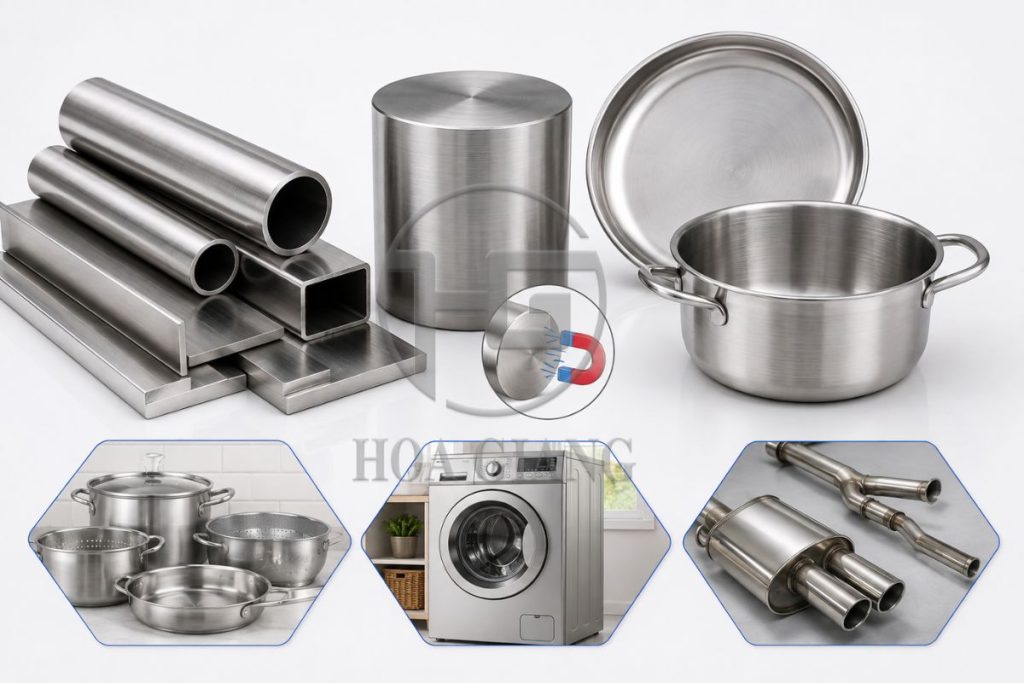
Applications of stainless steel 430
Application:
- Manufacturing of common household items: pots, pans, serving trays.
- Washing machine casing, household electrical appliances
- Car exhaust pipes, accessories
Inox 410, Inox 420
Martensitic groups have a higher carbon content, which can be hardened to increase hardness and mechanical strength, but they have poorer corrosion resistance than other groups.
Key features:
- High hardness and good wear resistance after heat treatment.
- Magnetic
- Limited corrosion resistance
Application:
- Knives, scissors, cutting tools
- Shafts, bearings, and load-bearing mechanical components.
- Medical surgical instruments (line 420)
Duplex Stainless Steel – Combining superior advantages
Duplex stainless steel combines austenitic and ferritic structures, resulting in twice the mechanical strength of conventional stainless steel along with excellent corrosion resistance.
Key features:
- Outstanding tensile strength and yield strength
- Good resistance to cracking and corrosion.
- High cost, mainly used in heavy industry.
Application:
- Oil and gas industry, petrochemicals, offshore exploration
- Wastewater treatment plant, industrial chemicals
- Load-bearing structures in highly corrosive environments.
3. Quick comparison table of common types of stainless steel
Below is a quick comparison table of common types of stainless steel based on characteristics, corrosion resistance, cost, and practical applications.
| Type | Group | Magnetism | Corrosion resistance | Price | Application |
| 304 stainless steel | Austenitic | Are not | Good | Medium | Household goods, food, healthcare |
| 316 stainless steel | Austenitic | Are not | Very good | High | Maritime, chemicals, specialized healthcare |
| Stainless steel 201 | Austenitic | Weak | Medium | Short | Common household appliances |
| Stainless steel 430 | Ferritic | Have | Medium | Short | Electrical appliances, household goods |
| Stainless steel 410/420 | Martensitic | Have | Least | Medium | Knives, scissors, mechanical tools |
| Inox Duplex | Duplex | Yes (slightly) | Very good | Very high | Heavy industry, oil and gas |
4. Simple ways to distinguish different types of stainless steel at home.
To avoid buying low-quality stainless steel by mistake, you can apply some quick testing methods as follows:
- Using magnets: Stainless steel 304 and 316 are almost non-magnetic or very weakly magnetic; stainless steel 201 and 430 are noticeably magnetic.
- Observe the surface: Stainless steel 304 is usually shiny and smooth; stainless steel 201 is prone to yellowing and tarnishing after prolonged use.
- Test with acid: Use a specialized stainless steel testing solution (reagent) to accurately determine the steel grade.
- Check the stamps and documents (CO, CQ): You should buy stainless steel from a reputable source with complete certificates of origin.
5. Common types of stainless steel surfaces
Besides choosing the type of stainless steel, the surface finish also greatly affects the aesthetics and usability of the product.
Hairline brushed stainless steel
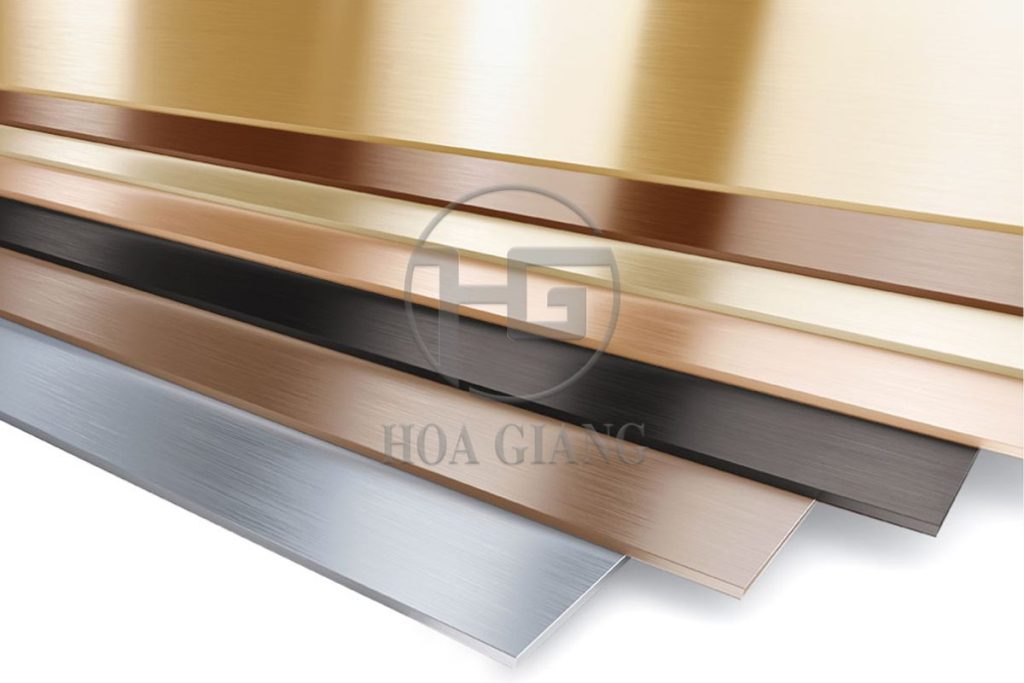
Hairline brushed stainless steel supplied by Hoa Giang.
Hairline textured surfaces feature fine, even scratches running in one direction, creating a modern and sophisticated feel. This is one of the most popular surface styles in interior design and architecture.
Matte stainless steel
The matte stainless steel surface is treated using a sandblasting method to create a uniform, matte effect. This type of finish is suitable for modern designs and minimizes reflections.
PVD-coated stainless steel
PVD is a surface treatment technology that creates a variety of colors and effects for stainless steel. Some popular colors include Champagne, Bronze, Black Titanium, and rose gold.
This is a popular choice in high-end interior design projects due to its ability to combine color, durability, and aesthetics.
Mirror stainless steel
Mirror-polished stainless steel has a high-gloss finish, creating a mirror-like reflective effect. This surface is often used for decorative details that need to create a focal point.
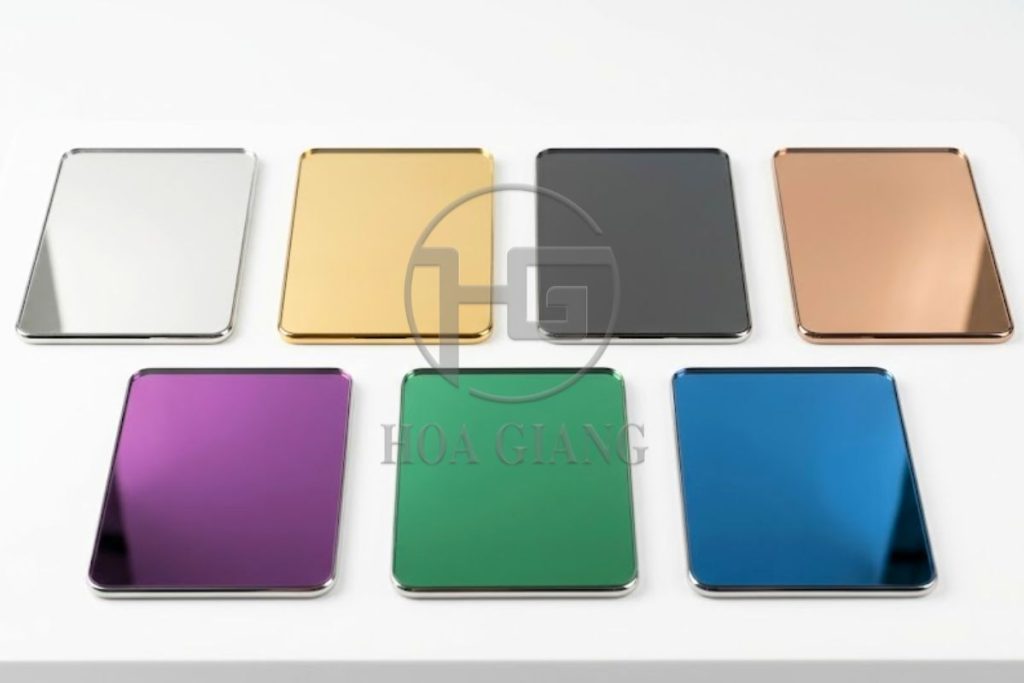
Mirror-finish stainless steel supplied by Hoa Giang.
Factors to consider when choosing stainless steel
To choose the right type of stainless steel, you shouldn’t rely solely on price. Several important factors need to be considered, including:
Usage environment: Indoor, outdoor, coastal, or chemical environments will have different requirements.
Corrosion resistance: This is especially important for buildings with high humidity or those frequently exposed to salt and chemicals.
Aesthetic requirements: The colors and surface textures should be consistent with the overall design.
Processing method: Laser cutting, CNC machining, bending, welding, and surface treatment all affect the quality of the finished product.
Modern laser cutting technology at Hoa Giang factory.
Investment costs: You shouldn’t choose stainless steel just because it’s cheap if the usage conditions require a material with higher corrosion resistance.
FAQ – Frequently Asked Questions about Stainless Steel
What type of stainless steel is most popular today?
304 stainless steel is one of the most commonly used types of stainless steel due to its good corrosion resistance, ease of processing, and suitability for many applications.
Which is better, stainless steel 201 or stainless steel 304?
Stainless steel 304 has better corrosion resistance than stainless steel 201 and is suitable for a wider range of applications. Stainless steel 201 has the advantage of lower cost, making it suitable for applications that do not require extremely high corrosion resistance.
Is 316 stainless steel better than 304 stainless steel?
In terms of corrosion resistance in harsh environments, 316 stainless steel has an advantage over 304 stainless steel. However, 316 stainless steel is more expensive, so it’s not always necessary to use it.
Which type of stainless steel is not attracted by a magnet?
Austenitic stainless steels such as 304 and 316 are essentially non-magnetic. However, after deformation processing, some products may exhibit slight magnetism.
Does stainless steel rust?
Stainless steel has good corrosion resistance, but that doesn’t mean it’s completely immune to corrosion. The degree of corrosion resistance depends on the composition of the stainless steel, the environment in which it is used, the surface quality, and the storage process.
Hoa Giang – A supplier of high-quality stainless steel for all construction projects.
With nearly 20 years of experience in the leading production and installation of decorative stainless steel in Vietnam, Hoa Giang offers a diverse collection of materials, fully meeting the material needs of many projects, from interior design and architecture to industrial production.
With its expertise and superior production capabilities, Hoa Giang has partnered with thousands of clients.projectboth domestically and internationally.
Hoa Giang offers a diverse collection of materials.
Each The products are custom-made to specifications regarding dimensions, color, and surface finish, ensuring both aesthetics and durability for each project.
Conclude
Each type of stainless steel has its own characteristics and range of applications. Stainless steel 201 Suitable for cost-priority needs, 304 stainless steel It is a versatile choice for many fields, while 316 stainless steel Suitable for environments with high corrosion resistance requirements. In addition, 430 and 410 stainless steel It also has its own advantages in household and mechanical applications.
Understanding the characteristics of common types of stainless steel This will help in selecting the right materials, optimizing costs, and ensuring the durability of each project and product.
HOA GIANG STAINLESS STEEL
Fanpage: Hoa Giang Stainless Steel Group
Hotline: 0918311491 – 0949805203


